
Manufacturing Orchestration Cockpit

Where this Applies
Manufacturers of highly engineered industrial equipment often operate in make-to-order and engineer-to-order environments where a single sales order item can drive multiple production orders, logical or phantom structures, shifting material priorities, and evolving build dependencies.
This solution is especially relevant where standard ERP execution remains in place, but planners still need a unified operational view across header orders, feeder orders, component readiness, shortages, sequencing, and downstream delivery commitments.
It is well suited for organizations that:
Build complex products through a mix of real production orders and logical or phantom structures
Need planner visibility across linked orders for a specific sales order item
Manage frequent shortages, changing priorities, and evolving engineering requirements
Require better coordination between manufacturing execution, project milestones, installation activities, or service commitments
Want stronger build orchestration without replacing the ERP core or disrupting existing execution processes
Business Challenge
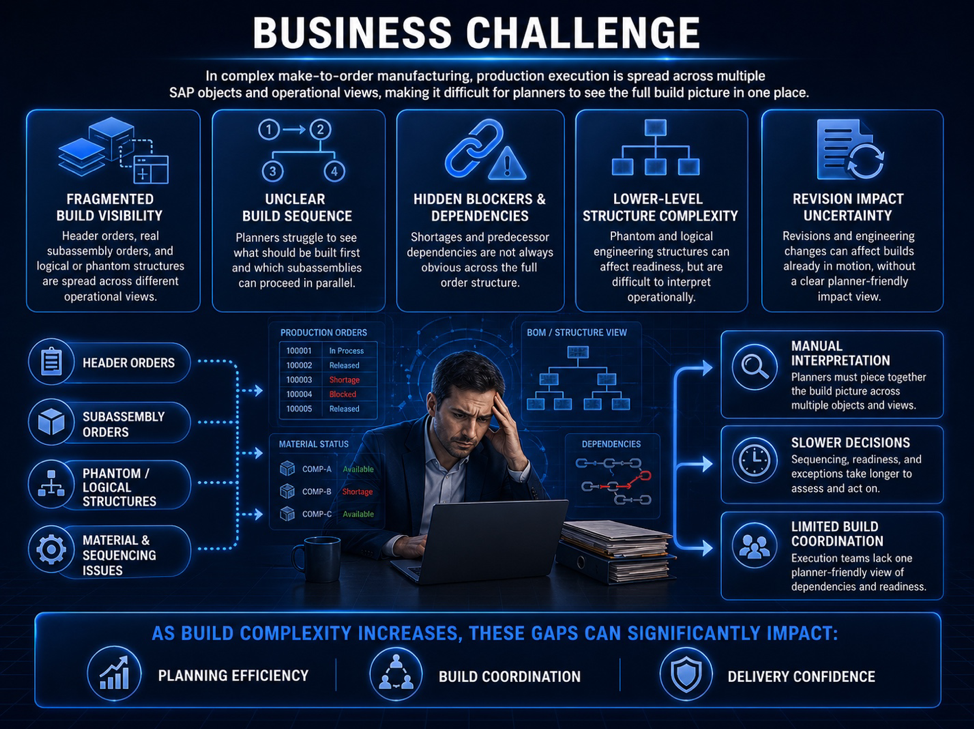
In complex make-to-order manufacturing, production execution is often spread across multiple SAP objects and operational views. A single customer sales order may result in a header production order, multiple real subassembly production orders, lower-level phantom or logical engineering structures, and ongoing material or sequencing issues that are not easy to interpret in one place.
In some environments, SAP collective orders may be a natural fit for representing multi-level production flow. However, not every manufacturer can adopt that approach cleanly. In SAP S/4HANA Cloud Public Edition, collective orders must use automatic goods movements, and SAP also documents restrictions for variance settlement with moving-average-priced materials. For manufacturers that rely on moving average valuation for produced materials, this can create a meaningful design constraint when considering collective-order-based production models.
As a result, some organizations may choose or be forced to run with a hybrid production model using standard production orders, phantom structures, and sales-order-based loose linkage instead of a fully native collective-order hierarchy. Even when production orders are tied back to the same sales order item, planners may still lack a clear operational view showing:
What should be built first?
Which subassemblies can proceed in parallel?
What is blocked by shortages or predecessor dependencies?
How lower-level engineering structures affect execution readiness?
How revisions or engineering changes impact the build already in motion?
In these environments, standard ERP transactions remain essential for execution, but they do not always provide a single planner-friendly picture of build dependencies, sequencing, and readiness across the full order structure.
Solution
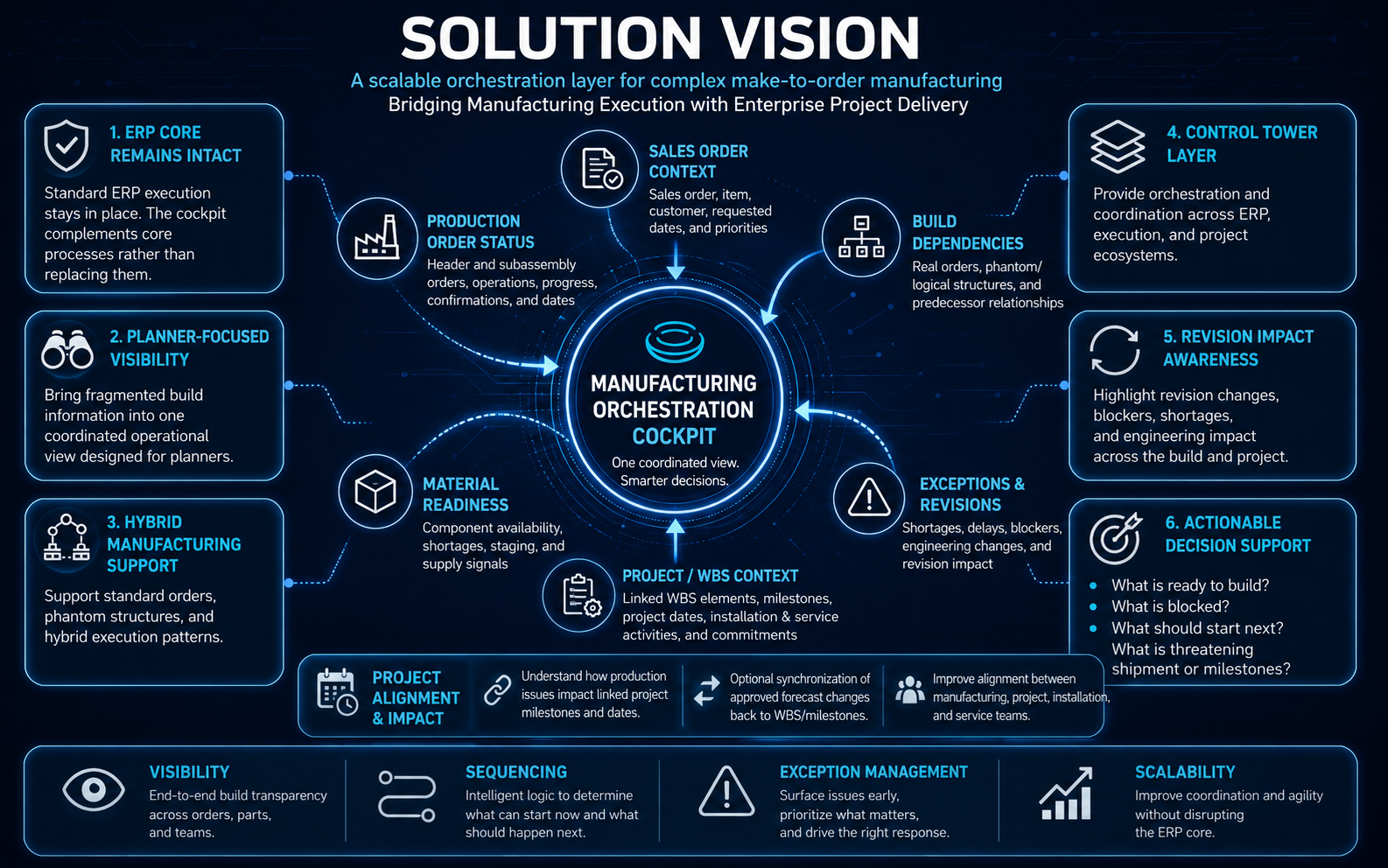
The Manufacturing Orchestration Cockpit is envisioned as a planner-focused orchestration layer on SAP Business Technology Platform that would unify build visibility across sales orders, header production orders, real subassembly orders, logical/phantom structures, material readiness, exception conditions, and related enterprise project structures such as WBS elements and milestones.
Rather than replacing SAP production execution or project controls, the cockpit would complement SAP S/4HANA by reconstructing the operational build view for a specific sales order item and presenting it in a way that helps planners and coordinators make faster, better-informed decisions.
In many industrial manufacturing environments, production execution is closely tied to project delivery. A customer order may drive not only manufacturing orders, but also WBS-linked activities, milestone dates, installation planning, and downstream service execution. The cockpit is intended to connect these perspectives by showing how shortages, sequencing issues, and production delays affect both the build itself and the broader project timeline.
The concept is intended to provide:
One build view across all relevant production objects for a sales order item
Dependency-based sequencing and readiness logic
Visibility into shortages, blockers, and predecessor relationships
Exception-driven worklists for planners
Revision and change impact visibility where build structures evolve
Visibility into linked project/WBS context and milestone impact
Optional synchronization of approved forecast updates back to connected project structures where required
Key Capabilities
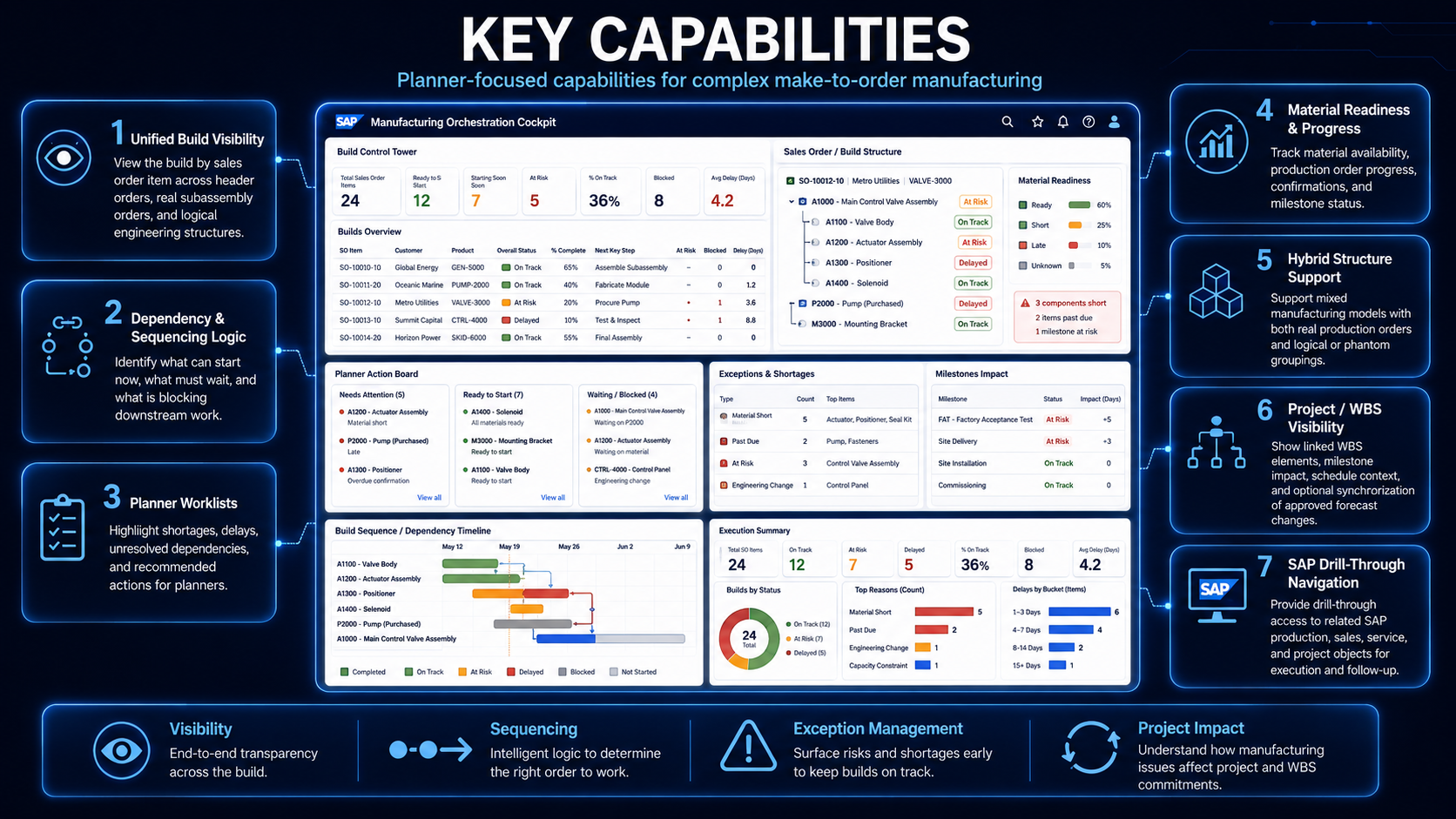
Unified build visibility by sales order item across header orders, real subassembly orders, and logical engineering structures
Dependency and sequencing logic to indicate what can start now, what must wait, and what is blocking downstream work
Planner worklists highlighting shortages, delays, unresolved dependencies, and recommended actions
Visibility into material readiness, production order progress, confirmations, and milestone status
Support for hybrid manufacturing structures with both real production orders and logical or phantom groupings
Visibility into linked project and WBS context, including milestone and schedule impact
Optional synchronization of approved manufacturing forecast changes back to connected project/WBS objects
Change and revision impact awareness across both build execution and project commitments
Drill-through navigation to underlying SAP production, sales, service, and project objects
Technology Stack
SAP Business Technology Platform (BTP)
SAP S/4HANA Cloud
SAP Build / SAPUI5 user experience
CAP-based services and integration layer
SAP APIs and OData services for production, sales, and material data
Impact
Improved planner visibility across fragmented production structures
Faster identification of build blockers, shortages, and sequencing issues
Better coordination between engineering structure and shop-floor execution
Improved alignment between manufacturing execution and linked project/WBS milestones
Better visibility into downstream impact on installation, service, and delivery commitments
Stronger decision support where native collective-order-style visibility is limited, impractical, or constrained by costing design choices
Results
The Manufacturing Orchestration Cockpit is being shaped as a practical way to improve build visibility in complex production environments where standard ERP execution remains intact, but operational coordination still depends heavily on manual interpretation.
It is particularly relevant where businesses want collective-order-like planner visibility, but their SAP design relies on standard production orders, phantom structures, or hybrid execution patterns instead of a fully native collective-order model. It may also serve as an added control-tower layer for planner coordination, revision impact visibility, exception management, and alignment between manufacturing and project delivery.
By bringing together sales-order context, production-order status, logical build dependencies, material readiness, exception management, and linked project/WBS milestones into one planner-focused view, the concept is intended to help teams quickly understand what is ready, what is blocked, what should start next, and what issue may be threatening shipment, installation, or project commitments.
The goal is to provide a scalable orchestration layer that improves both manufacturing build coordination and downstream project alignment without forcing unnecessary disruption to the ERP core.
What About Process Manufacturing?
While the Manufacturing Orchestration Cockpit is currently positioned around complex discrete manufacturing, the same orchestration approach can also extend into process manufacturing. In those environments, the focus would shift toward process orders, recipes, phases, batch readiness, material availability, and execution sequencing.
The underlying need remains similar: giving planners a clearer view of what is ready, what is blocked, and what issue may affect downstream supply or delivery. Over time, this orchestration model can be adapted to support process-industry scenarios where improved visibility across process execution objects would create similar planning value.